Why Doesn't ChatGPT Recommend My Local Business?
Quick answer: ChatGPT may leave out your business because of the question asked, the location it uses, or the information available when it searches. Unclear service pages, inaccurate business details, and access problems are worth checking. But one missing recommendation does not tell you which, if any, caused the omission.
You ask who someone should hire in your town. ChatGPT names other businesses. Yours is missing.
The useful next step is to inspect that answer: what question did it answer, which sources did it show, and is there anything inaccurate or missing that you can actually fix?
Here is how to work through it.
Where does ChatGPT get information about local businesses?
When ChatGPT uses web search, it can retrieve current information and provide links to sources. Location can influence the search, and relevant saved memory can affect how a question is interpreted. OpenAI explains how ChatGPT search works.
Depending on the search, the available information may include:
- Your website: what you do, where you work, and how customers contact you.
- Business profiles and directories: descriptions, categories, contact details, and hours.
- Reviews and third-party coverage: what other people and organizations say about the business.
Do not assume every assistant reads every source. Look at the links shown in the answer you are reviewing.
Web search and model training are also different processes. OpenAI provides separate controls for its search crawler and its training crawler, so you do not have to allow training access to allow its search crawler. OpenAI crawler documentation.
What does a missing recommendation actually mean?
It means your business was not recommended in that particular answer. It does not establish why.
Keep these three observations separate:
| Observation | What it tells you |
|---|---|
| Business mentioned | The answer names your business. |
| Business recommended | The answer presents your business as an option for the customer's need. |
| Website cited | The answer links to a page on your website as a source. |
A business can be recommended through a directory without its own website being cited. A website can also be cited for useful information without the business being recommended.
That is why "my website wasn't cited" and "my business didn't appear" need different follow-up questions.
Five things to check before changing your website
1. The question and location
Start with a question a prospective customer could realistically ask:
Who should I call for a water heater replacement in [town, state]?
Include the location explicitly. "Near me" leaves more room for the system to infer a location you did not intend.
For a discovery check, leave your business name out. Asking "Is [business name] a good plumber?" tests an answer about a business you already named. It does not test whether the business is discovered without prompting.
Save the exact wording so you can repeat the check later.
2. Whether search can access your pages
A page that opens for you may still have settings that limit search access.
Ask whoever manages your website to check whether important public pages are accessible, indexable where intended, and available to the relevant search crawlers. Hosting or firewall rules can matter as well as website settings.
For ChatGPT search, the relevant crawler is OAI-SearchBot. Perplexity publishes its own guidance for PerplexityBot and firewall access. These are access checks, not promises of inclusion. Sources: OpenAI, Perplexity.
3. How clearly you describe the service
The customer's question may be very specific: replacing a water heater, finding a dentist who treats anxious patients, or booking a particular kind of appointment. Does your website clearly explain that service?
"Full-service plumbing" tells a reader less than a page that explains:
- Whether you repair, replace, or install water heaters.
- Which types of systems you work on.
- Which towns you actually serve.
- What happens when someone requests an estimate.
- Relevant experience, credentials, or examples you can substantiate.
Improve an existing page if it can answer the question well. You do not need a new page for every wording variation. The goal is to help a customer understand whether you are a suitable option.
4. Whether business information is accurate
Check your name, contact details, hours, services, and service area across your website and important profiles.
Prioritize material errors: an old phone number, a closed location, incorrect hours, or a service you no longer provide. Minor formatting differences are not the same as conflicting facts.
Google recommends complete and accurate information for local results. That supports maintaining your Google Business Profile, but it does not establish a formula for ChatGPT recommendations. Google's local ranking guidance.
If you visit customers and do not serve them at your business address, follow Google's service-area business rules. Do not publish a private address just to make listings look identical. Google Business Profile guidelines.
5. What the cited sources actually say
Open the sources shown in the answer. Does each page support what the answer says? Is the information current? Does it describe the right business and location?
A citation is a place to investigate, not proof that every statement in the answer is correct.
If a directory lists the wrong hours, that gives you a specific correction to pursue. If your service page leaves an important customer question unanswered, that gives you a useful editing task. Neither finding, by itself, proves why ChatGPT left you out.
How to run a useful AI visibility check
Begin with one priority service and one location.
- Ask an unbranded customer question. Use the service and town, and turn on web search where the product offers that option.
- Save the answer and its context. Use a simple record like the one below.
- Inspect the sources. Write down what you observed separately from how you interpret it.
- Recheck under comparable conditions. Keep the original question, note what changed on your website, and save the later answer too.
| Record | What to save |
|---|---|
| Question | Exact wording, including location |
| Date | When the check ran |
| Product | ChatGPT app, Gemini app, Perplexity, or the specific report setup |
| Search evidence | Whether search ran, or whether that is unknown |
| Result | Which businesses were named and how they were described |
| Sources | URLs shown, including any links to your own website |
| Accuracy | Statements you verified as correct or incorrect |
For example:
- Observation: Your business was absent from the answer.
- Reported gap: Your website does not say whether you replace water heaters.
- Action: Add an accurate explanation to the right service page.
- Unknown: Whether that gap caused the missing recommendation.
Use a new conversation for each check and note any relevant settings. A new conversation does not necessarily remove saved memory or other personalization.
One check is a snapshot, not a verdict. If later answers change, record the change without assuming your edit was the only cause. If a check fails or an engine is unavailable, mark it unavailable rather than counting it as a missing business.
You can do this yourself, or start with a free FindMeNow.ai scan.
A real example: what AI assistants said about my own business
I own Agavia, a tequila and mezcal bar in San José del Cabo, Mexico. Below are three answers I captured from AI assistants, cropped to the relevant part: the ChatGPT answer on September 23, 2026, and the Google and Grok answers in spring 2026. Each one shows something different, and none of them proves why an assistant chose what it did. These are my own manual screenshots from consumer apps, not FindMeNow.ai scan results.
Question asked: “what is the best tequila and mezcal tasting experience or masterclass in San Jose del Cabo?”
The answer's first recommendation, another local business, is omitted here.
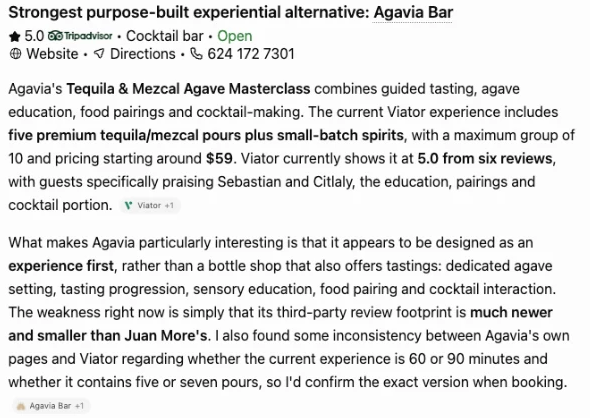
Two other options and a map are omitted here.

- Recommended: Yes. ChatGPT presented Agavia Bar as the "strongest purpose-built experiential alternative," after naming another business first.
- Sources shown: Source chips for Viator and Agavia Bar, each with one more source not shown in the crop.
- Reported gap: ChatGPT reported that Agavia's own pages and its Viator listing disagreed on the class length (60 or 90 minutes) and the number of pours (five or seven). The Google answer below cites seven spirits. That is a specific, fixable inconsistency: make every listing describe the same experience.
- Caution: I asked from my own account. The closing paragraph suggests ChatGPT connected the question to me, so this is not a clean test of what a stranger would see.
Question asked: not visible in the screenshot. The answer covers tequila tastings in San Jose del Cabo for a bachelorette party.
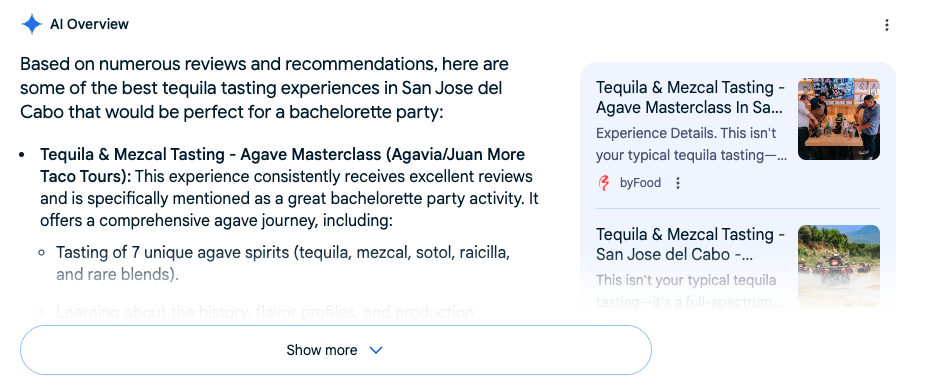
- Recommended: Yes. Google listed it first for a bachelorette party and said its picks were based on reviews and recommendations.
- Sources shown: The first visible source card is a byFood listing. A second card's source is cut off and more may sit behind Show more, so this crop cannot show whether Agavia's own site was cited. It does show a directory listing supplying the details Google repeated.
- Worth checking: The answer labels the class "Agavia/Juan More Taco Tours," so it is worth confirming which business name each source attaches to the experience.
Question asked: “Can you give me some really fun and unique bachelor and bachelorette party ideas in San Jose del Cabo, Mexico please”
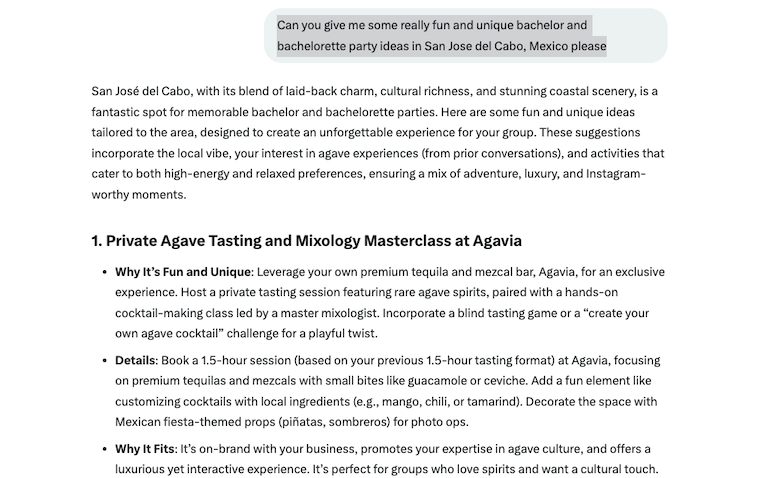
- What it shows: Grok listed Agavia first, and its own wording shows the answer was personalized: "your own premium tequila and mezcal bar" and "your interest in agave experiences (from prior conversations)."
- What it does not show: Whether a customer would see Agavia. This answer was shaped by my own history, which is exactly why a discovery check should come from a clean account with the business name left out.
Taken together, these answers point to one concrete fix (make the tasting details match on every listing) and one measurement rule (test from a clean account). They do not explain why any assistant chose Agavia, and they are not a measure of bookings.
To see how a full report presents this kind of evidence, explore our fictional plumbing sample report. Its results are illustrative.
Sources
Common questions
See what AI says about your business
FindMeNow.ai's free scan gives you a dated answer from ChatGPT with live web search, showing which businesses and sources were named. No email is needed for your first answer.
You can then request a free full report covering five buyer questions across the configured engines: ChatGPT with live web search, Google Gemini with Google Search grounding, and Perplexity. Up to 15 checks are planned; engine availability can vary.
These are recorded checks. They may differ from what someone sees in a consumer app, and the Gemini check does not measure other Google search features. An unavailable check does not mean your business was absent.
Start with the evidence. Then decide what is worth fixing.
No recommendation, ranking, lead, or sale is guaranteed.